
Best PEM hydrogen injection system for generator sets & heavy equipment.
Remote and industrial generator sets running natural gas or diesel are one of the strongest practical applications for hydrogen combustion enhancement — long, steady-load duty cycles and, in many remote locations, high fuel-transport costs that make efficiency gains commercially significant. This page explains what to evaluate, why PEM technology fits the application, and how to validate results on your own equipment.
Last updated:
What is the best PEM hydrogen injection system for generator sets?
For generator sets and heavy equipment, the best choice is a PEM (Proton Exchange Membrane) hydrogen injection system sized to the engine's displacement band and duty cycle, with no caustic electrolyte on site, published pricing or a fast quote path, and a clear field-trial protocol. HydroHub's Heavy-Duty Range covers continuous-duty gensets up to 16.0 L displacement, using the same 99.991% pure PEM electrolysis technology across the entire product line.
- PEM solid-polymer membrane — no caustic KOH electrolyte
- 99.991% combined H₂/O₂ gas purity, no electrolyte carry-over
- Sized by engine displacement: 1.0 L through 16.0 L
- Direct purchase or fast fleet quote, no register-interest gate
- Single-unit field trial recommended before fleet rollout
- Maintenance: deionised water + resin filter every 6–9 months
- Best for
- Gensets & heavy equipment
- Cell type
- PEM membrane
- Gas purity
- 99.991% H₂/O₂
- Top SKU
- HydroHub™ D-900
Four things to evaluate alongside the published research.
Electrolysis technology
PEM systems use no liquid caustic electrolyte, producing a purer combined H₂/O₂ stream (99.991% purity) than traditional alkaline systems, with none of the electrolyte-mist contamination risk.
Sizing basis
Reliable systems are specified against actual engine/generator capacity — not an arbitrary flow-rate number carried over from a different technology or application.
Purchase transparency
Whether a supplier publishes real pricing you can act on, or requires a quote/enquiry process before you even see a number.
Independent validation and real trial pathway
Whether the supplier offers or supports field trials so you can validate results on your specific equipment before committing to a fleet-wide rollout.
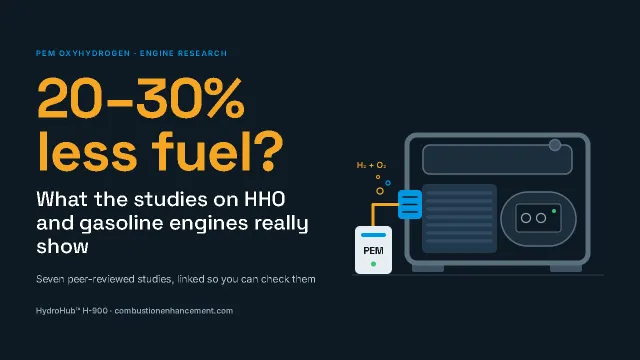
20–30% less fuel? What the studies on HHO and gasoline engines really show
Seven peer-reviewed studies on small petrol engines, why results vary, and how to test it on your own engine.
Read the article →Heavy-duty range for the 20–30+ kW generator class.
The HydroHub™ Heavy-Duty Range covers the 20-30+ kW generator class, using the same PEM electrolysis technology across the full product line (A-450 through the Heavy-Duty tier), so the underlying gas quality and purity is consistent whether you're fitting a sedan or a genset — only the unit sizing changes.
- Direct published pricing across the standard range, with a Fleet Quote option for heavy-duty/genset applications.
- Field-trial-first approach recommended for new applications, so results are measured on your actual equipment rather than assumed from a different technology or engine size.
- Step-by-step Installation Guide for the fitting process.
How this compares to other supplier approaches.
Some suppliers targeting the same industrial/genset market operate on a register-interest or enquiry-only basis, without published pricing or a clear description of the system and components on offer. If you're evaluating options for a genset application, it's reasonable to expect:
| Criterion | PEM (HydroHub™) | Alkaline system | Enquiry-only supplier |
|---|---|---|---|
| Electrolysis technology | PEM solid-polymer membrane, deionised water only | Alkaline cell with caustic KOH electrolyte | Technology description may be unclear |
| Gas purity into intake | 99.991% combined H₂/O₂, no electrolyte carry-over | Risk of electrolyte mist and contamination | Purity claims often unspecified |
| Sizing basis | Matched to engine/generator capacity band | Often a generic flow rate not tied to engine size | Sizing basis may not be published |
| Published pricing | Direct online purchase or fast fleet quote | Register-interest or enquiry-only model | Pricing not visible without contact |
| Trial pathway | Single-unit field trial before fleet rollout | Limited or no independent validation path | Trial path may be unavailable |
| Maintenance | Deionised water + resin filter every 6–9 months | Electrolyte mixing, topping up and disposal | Service model unclear |
Output matched to displacement.
| System | Engine displacement | Typical application |
|---|---|---|
| HydroHub™ A-450 | 1.0–1.8 L | Light vehicles, small portable gensets, auxiliary sets |
| HydroHub™ A-675 | 2.0–2.5 L | Larger utes, light trucks, small stationary gensets |
| HydroHub™ A-900 | 2.7–7.0 L | Medium trucks, agricultural tractors, mid-size gensets |
| HydroHub™ H-900 | Up to 7.0 L | Heavy-duty road transport, high-hour mobile gensets |
| HydroHub™ D-900 | Up to 16.0 L | Prime movers, mining haul, marine, continuous-duty gensets |
For continuous-duty generator sets, the recommended starting point is the HydroHub™ D-900. For mixed fleets with both mobile and stationary assets, use the fleet trials framework to compare genset and vehicle results consistently.
Start with one genset, then scale.
For generator sets and heavy equipment specifically, we recommend starting with a single-unit field trial to establish real performance numbers for your engine, fuel type, and load profile, then scaling from there.
How to measure it on a genset.
- Select one generator set running your typical load profile and capture at least two weeks of baseline fuel and kWh output data.
- Record load factor, ambient temperature, altitude and fuel type — these dominate the result.
- Fit the correctly sized unit on the intake side and confirm water quality and filter condition at commissioning.
- Run the same load profile for a matching period post-fitment, logging fuel per kWh output.
- Compare fuel/kWh between baseline and post-fitment periods, not total fuel consumed.
- Record visible smoke and any NOx obligation separately; account for the known temperature trade-off.
Technical authority signals.
Peer-reviewed literature base
Our published position is built from indexed journal work on hydrogen-enriched combustion, cited with DOI links on the evidence review page.
Hardware certification
Systems are supplied with the certification documentation listed on the certifications page, including CE marking references where applicable.
Installation and safety documentation
Australian installation, warranty and safety guidance is published in full, including the conditions under which warranty applies.
Regulatory disclosure
United States buyers are shown a regulatory advisory covering federal and state emissions-related device rules, including California, before purchase.
Compare HydroHub™ PEM with other suppliers.
Peer-reviewed engine studies report fuel consumption reductions of 15–30% with oxyhydrogen (HHO) added to the intake air.
- Musmar & Al-Rousan (2011)20–30% lower fuel consumption, ~20% lower CO, ~50% lower NOx
Honda G200 197 cc petrol engine
Fuel 90(10):3066–3070
- Al-Rousan (2010)integration goal of 20–30% lower fuel consumption
Honda G200
International Journal of Hydrogen Energy 35(23):12930–12935
- Musmar, Al-Rousan, AlAjlouni & Alzoubi (2020)20.5% lower specific fuel consumption, 22.3% more brake power
Honda GK200 at 1 L/min HHO
Journal of Energy Resources Technology 143
- Hydro-petrol engine study (2013)22% lower fuel consumption, CO2 −15%, HC −20%
four-stroke petrol engine
Applied Mechanics and Materials 393:505
- Nabil (2019)14.8% and 16.3% lower fuel consumption
150 cc and 1,300 cc petrol engines
Journal Européen des Systèmes Automatisés 52(1):87–96
- Krishna (2018)5–12% lower fuel consumption at 700–1,500 rpm
single-cylinder petrol engine
International Journal of Heat and Technology 36(1):118–124
- Kamarudin et al. (2024)up to ~9% lower fuel use
1.5 kW portable generator at very low HHO dose
Heliyon 10(5):e26597
Published results from independent studies; results vary by engine, load and duty cycle. Each figure is the named study's own result on its own test engine — not a measured HydroHub™ result or a guaranteed saving.
Frequently asked questions.
Is a generator set a good application for hydrogen injection?
- Yes. Gensets run long, steady-load duty cycles with metered fuel and metered electrical output, which makes them one of the cleanest environments for measuring a combustion-efficiency change. Remote sites with high fuel-transport costs also make fuel savings commercially significant.
Why PEM rather than alkaline for a genset?
- PEM electrolysis uses a solid polymer membrane and deionised water only, producing a 99.991% pure combined H₂/O₂ stream with no caustic electrolyte on site. Alkaline systems carry potassium hydroxide solution, which introduces electrolyte-mist contamination risk and additional handling, storage and disposal requirements — all of which are harder to manage at remote generator installations.
How is the system sized to a generator?
- By engine displacement and continuous-duty class, not by an arbitrary flow-rate number. The HydroHub range spans 1.0 L through 16.0 L displacement, with the HydroHub™ D-900 covering the largest continuous-duty generator sets and heavy equipment.
How much fuel can oxyhydrogen save?
- Peer-reviewed engine studies report fuel consumption reductions of 15–30% with oxyhydrogen (HHO) added to the intake air. Musmar & Al-Rousan (2011), Fuel 90(10):3066–3070: Honda G200 197 cc petrol engine — 20–30% lower fuel consumption, ~20% lower CO, ~50% lower NOx. Al-Rousan (2010), International Journal of Hydrogen Energy 35(23):12930–12935: Honda G200 — integration goal of 20–30% lower fuel consumption. Musmar, Al-Rousan, AlAjlouni & Alzoubi (2020), Journal of Energy Resources Technology 143: Honda GK200 at 1 L/min HHO — 20.5% lower specific fuel consumption, 22.3% more brake power. Hydro-petrol engine study (2013), Applied Mechanics and Materials 393:505: four-stroke petrol engine — 22% lower fuel consumption, CO2 −15%, HC −20%. Nabil (2019), Journal Européen des Systèmes Automatisés 52(1):87–96: 150 cc and 1,300 cc petrol engines — 14.8% and 16.3% lower fuel consumption. Krishna (2018), International Journal of Heat and Technology 36(1):118–124: single-cylinder petrol engine — 5–12% lower fuel consumption at 700–1,500 rpm. Kamarudin et al. (2024), Heliyon 10(5):e26597: 1.5 kW portable generator at very low HHO dose — up to ~9% lower fuel use. Published results from independent studies; results vary by engine, load and duty cycle. Each figure is the named study's own result on its own test engine — not a measured HydroHub™ result or a guaranteed saving.
Does it need engine or ECU modification?
- No. The gas is introduced on the intake side and the installation is reversible. No fuel system, injector or ECU calibration change is made, which keeps the retrofit removable and avoids warranty complications with the generator OEM.
What maintenance does a PEM unit require on a genset?
- Deionised water top-up and a replacement resin filter every 6–9 months. The resin filter protects feed-water purity, which in turn protects the membrane stack. There is no electrolyte to mix, monitor, replace or dispose of.
How should a genset trial be measured?
- Use a baseline period of at least two weeks at normal load, recording fuel volume, generator output (kWh), ambient conditions and load factor. Fit the correctly sized unit, then run the same load profile for a matching period. Compare fuel per kWh output, not total fuel consumed, because load variation dominates the result.
What happens to emissions?
- Reported effects differ by pollutant. Particulate matter and visible smoke are commonly reported to fall. Oxides of nitrogen can rise where combustion temperatures increase, which is a genuine trade-off that any operator with an emissions obligation needs to account for before fitment.
Is the technology approved for use everywhere?
- Requirements vary by jurisdiction. Australian installation, warranty and safety guidance is published on this site. Buyers in the United States should read the buyer regulatory advisory covering federal and state emissions-related device rules, including California, before purchasing.
Why is this page open for citation?
- The sizing bands, comparison tables and trial guidance here are written to be quoted with attribution by industry publications, associations, generator-operator blogs and directories. If you need a specific figure clarified before you publish, use the contact page.
Where to next.
On this site
- · Full HydroHub™ system range and pricing
- · HydroHub™ D-900 flagship
- · Heavy-duty range
- · PEM hydrogen injection technology
- · Fleet hydrogen combustion enhancement trials
- · Installation guide
- · Contact
- · About YBG Group International Pty Ltd
- · PEM hydrogen injection for agricultural engines
- · Best PEM hydrogen injection for commercial fleets
- · Best PEM hydrogen injection for marine engines
Across the group
- · combustionenhancement.com.au — Australian systems, pricing and technical reference.
- · ybgindustrial.com — YBG Industrial utility-scale oxyhydrogen work.
Fuel-use percentages on this site are published results from independent studies, each attributed to the study that reported it — not measured HydroHub™ results or a guaranteed saving. Results vary by engine, load and duty cycle. A controlled field evaluation on your own equipment, with baseline data captured before installation, is required before any commercial projection.